
That's all for now.
If you require urgent support, contact me through this form.
Keep breathing and have a great rest of your day,

Dike
Dike Drummond MD
www.TheHappyMD.com
[Transcript]
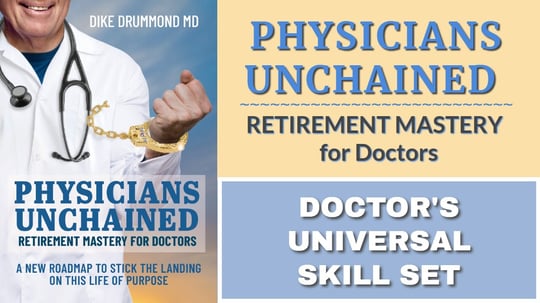
Physicians Unchained: Retirement Mastery for Doctors – Weekly Tip
~~~~~~~~
Sign up for the EARLY BIRD LIST HERE
https://support.thehappymd.com/physicians-unchained
My new book Physicians Unchained: Retirement Mastery for Doctors launching in ApriL The NEW ROADMAP to Stick the Landing on this Life of Purpose
~~~~~~~~
Your doctor's universal skill set means you will never be irrelevant in your life after medicine
You Do Not Become Irrelevant After Medicine
Hello, Dr Dike Drummond, MD, here again with the latest lesson from my new book, Physicians Unchained Retirement Mastery for Doctors. And what I want to do in this episode is give you some confidence going into your life after medicine that there's no way in the world that you become irrelevant simply because you're not seeing patients anymore.
What Doctors Actually Do All Day
Let's think about what a doctor does in the course of their day, especially a primary care doctor. What you do is you see multiple different people in their family settings, people you may have only just met that morning, all of them in distress, in rapid fire during the course of the day coming into you with a mystery.
And what do we do again on a very short time frame? Bang, bang, bang through the day. We take a history, we collect the different clues about what's going on. I think that the first half of being a doctor is being a detective, putting together the puzzle, and our goal is to find the unifying diagnosis. So we find the one thing that could explain all these different clues, and then we build a treatment plan to address that unifying diagnosis.
We take a history, we assemble the clues into a unifying diagnosis, and we propose a treatment plan on about a 10 minute timeline, multiple times during the course of a day. If you're not a primary care doctor, you do a version of this inside your specialty.
A Universally Valuable Skill Set
Now what I want you to know is that you have only experienced this thought process, this information gathering, conclusions and treatment plan in the setting of patient care. But I want you to know this is a universally valuable skill set. It's the essence of any problem solving effort in any setting.
What we need to do as doctors is relax and do the same kinds of things when the issues that we're being faced with have nothing to do with patient care. Because if you're in a business meeting, I don't care how high up it is, a boardroom, a C-suite. Doesn't matter what it is. As you listen to the discussion and you're having people tell you the issues with the business, use your clue finding, use your skills to create the unifying diagnosis for the problem this team is facing, and propose a course of action, a treatment plan.
And what you'll find is if you can relax into this, not having to be medicine specific, that your participation in any group like that is positive, that you are an asset to the group because of your ability to find the unifying diagnosis and propose a treatment plan, and especially because you can do it on an accelerated time schedule.
Your Effectiveness Grows
When you really get relaxed at this what you'll notice is that your effectiveness in this sort of executive problem solving gets better the less you know about the topic of the conversation. It doesn't have to be about medicine. It can be about any business topic, and you will be an asset to the room.
Just relax into this, and I think you'll find you're shockingly effective in ways that the people who are in the room and experts at this subject matter are unfamiliar with. You bring in the diagnostic and therapeutic skills of an experienced doctor, and it's really fun to do this in retirement.
Where These Skills Show Up After Medicine
When you're living your life after medicine, you may sit on boards or the PTA or the library leadership team. You're going to be asked to do all sorts of things once you're done seeing patients and you have some spare time. Say yes if it rhymes with your core values, and just relax into being the person in the room who is always the first to point out the issue and what you might want to do about it.
You earned this the hard way with tens of thousands of patient visits over decades of medical practice. Have fun.
Closing
That's it for today. If you're seeing me on social media, you're not on the early bird list. Somewhere on this page, there's a place where you can hit a link and sign up. Then you'll get an email tip like this every week, and you'll be one of the first people to know when the book is available later on here in the first quarter.
Keep being a light worker. Keep paying it forward. Keep breathing and I'll see you in the next video.